When I drop by Alannah Farrell’s studio space, in the upper reaches of 4 World Trade Center, after spending 45 minutes getting lost in the financial district, I have to show a government issued ID to the security guard downstairs. In a lot of ways the space, donated for artists to use by Silverstein Properties as part of a year long residency for the artists and a tax write-off for the owner, is the antithesis of every ‘artist studio’ cliché in the book: instead of bohemian grit one is greeted by a skyscraper, corporate and slick, with an expensive bank of elevators. Even the workspaces on the floor set aside for artists still retain something of the aura of day traders offices or bankers cubicles, despite the easels and canvases, brushes and paints.
The works on view at Farrell’s current show with Alexander Gray’s upstate New York Germantown gallery location are a little different from a lot of their previous work. Farrell cut their teeth in the New York art scene with a series of vividly colored and emotionally charged portraits that had an almost airbrushed quality.
Painting their acquaintances–including queer creatives, drag queens, and sex workers–always seemed a way of letting those people tell their stories for Farrell, so as we sit there, in front of a half-finished figure in vivid tones, I ask them about portraiture, and how the current show is different.
Farrell, who always paints from life when possible, describes the portraits that I’d seen at a previous show as collaborations between the sitter and the painter. They are also insistent that artists have a responsibility, when they send their creations out into the world, to think about how their work affects the public, and the subjects of their portraits. Perhaps this explains the easy intimacy of pieces like an (Clara), a canvas painted in cyanic and bubblegum hues, the sitter staring boldly out at the viewer while smoking a cigarette in pink panties and fishnets. I’m struck by the title of that piece, and Farrell tells me that the buildings and street scenes they painted for their current show, mononymously entitled Erect with a bit of tongue in cheek ambiguity, are as much portraits as any of their previous work.
Raised in upstate NY by a painter and then educated in photography at Cooper Union, Farrell has spent the majority of their adult life in New York City and is intimately acquainted with the subtle power play and politics of urban life. Towering, erect skyscrapers like the one in which we met represent dominion over light and air for those that can afford to live there, and pieces like Manpower underscore this tension, making it readily apparent why Ferrell claims that “rooms are portraits”. Currently on display at the show upstate, the painting clearly draws on the history of still life with slightly overblown roses in a glass of water and an ornate baroque clock in the foreground while the ever-present skyscrapers loom ominously behind, visible through a window in menacing purples and blacks. Manpower is as much a depiction of the contradictions of representing femininity and masculinity in our world as any of the transmasculine artist’s self portraits.
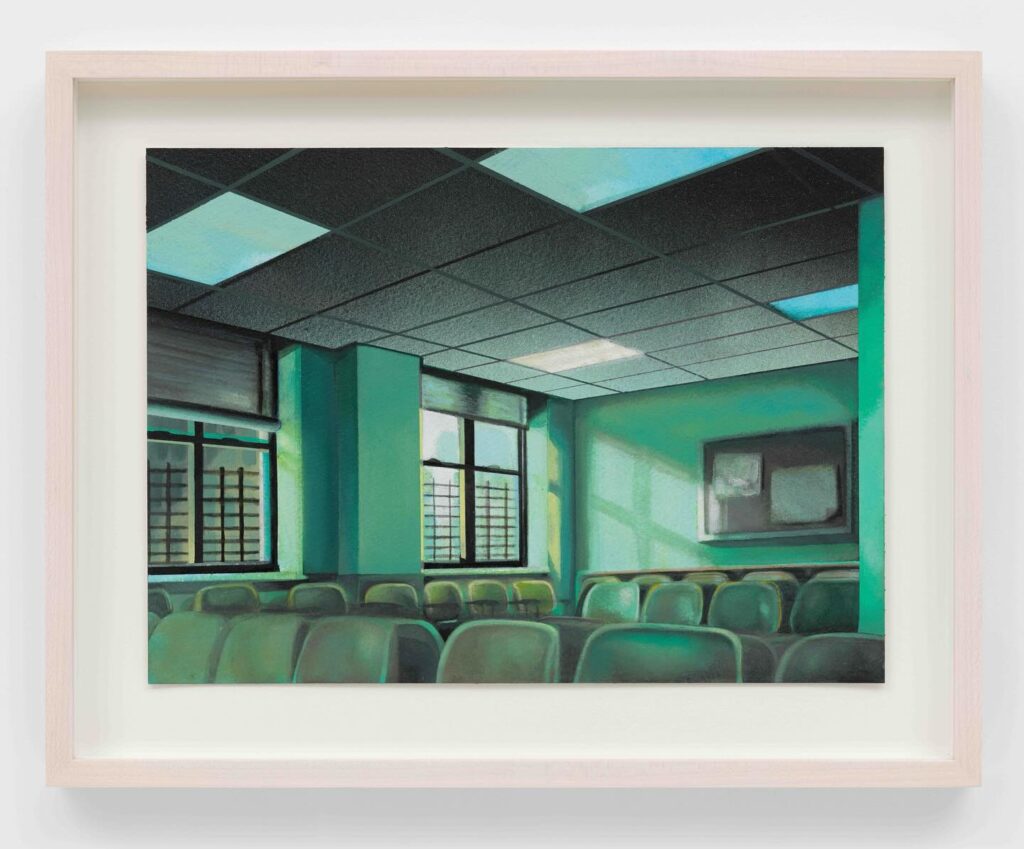
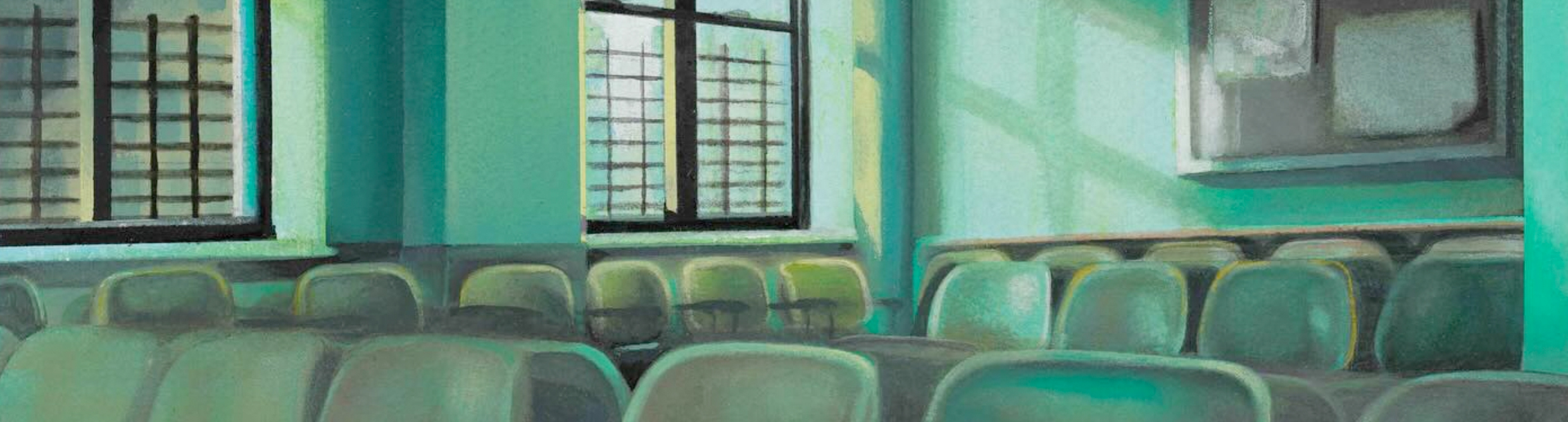
Farrell plays with these questions of ambiguity and representation in their work. In another empty room–empty of people at least–depicted in the show at Alexander Gray, a prison-like chamber is crammed with an array of desks strewn about under fluorescent lighting. And yet the piece is bright, cheerful even, drenched in greens and yellows it shows light streaming in the window past iron bars, the plasterboard ceiling panels somehow transformed through color into skylights.
I ask Farrell about this ambiguity and they tell me that they see both pure visual beauty and the communication of ideas as valid parts on “the spectrum of art”. Erect, they tell me, is both. The pieces in the show are about representing class and gender expectations and differential access to power, but they’re also intended to be lovely aesthetic objects. While painting the pieces they were musing on a quotation attributed to Emily Bronte: “having leveled my palace, don’t erect a hovel and complacently admire your own charity in giving me that for a home.” Given our current political moment and the looming housing crisis, both Bronte’s words and Farrell’s paintings seem oddly prescient.