
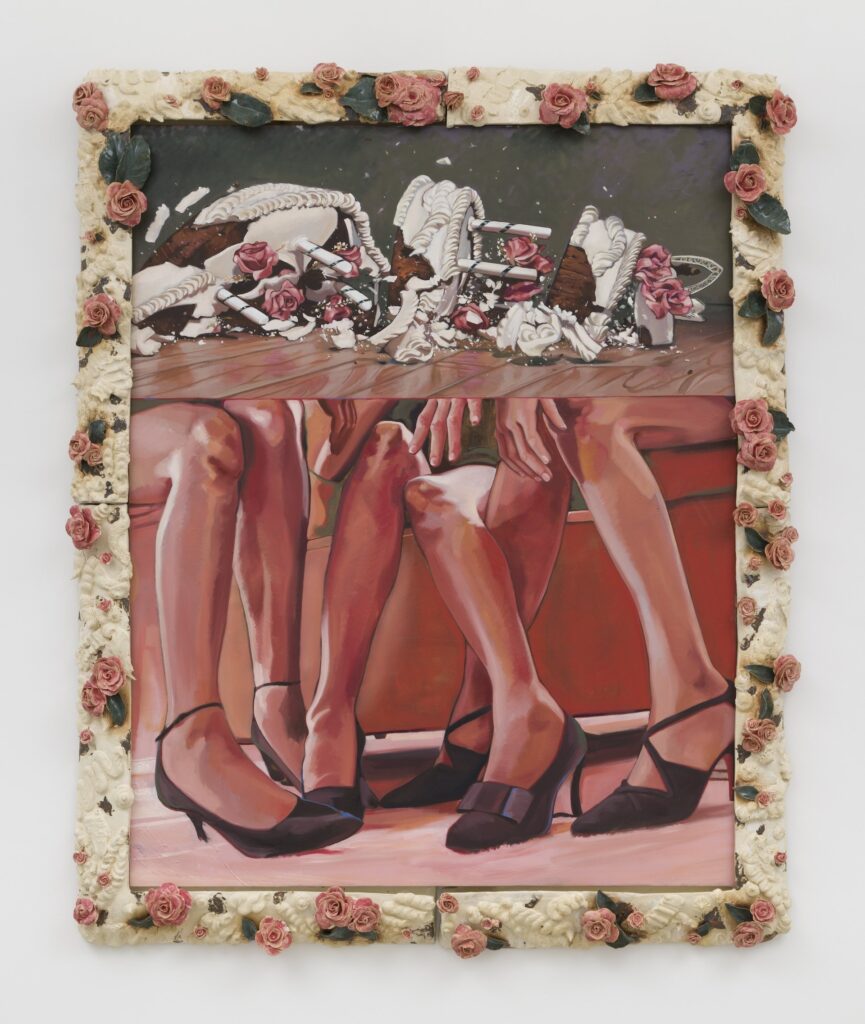
The glazed stoneware rosettes forming the frame surrounding Stephanie Temma Hier’s painting Her Psychology Today resemble frosting more than anything else. They have the same wooden, stiff, painted-on presence that a thick sugary can of Pillsbury would. The unusual frame would stand out in most white-walled Soho gallery spaces, but in the front room of Lyles & King, amidst the sculptural canvases, painted stoneware and found-object works by Hier and Kathy Ruttenberg, it seems almost expected.
A recurring sense of ambiguity in the pieces on exhibit in the two person show Between the Lines is revealed in wooly media descriptions which range from the exhaustive “clay, acrylic and oil paint, armature wire, found wooden drawer” to the more euphemistic “mixed media”. Are they paintings? Sculptures? Beyond the form, that in-betweenness is made manifest in the unapologetically feminine content of the works on display as well. The pieces on display are both feminine and feminist, garnished with frivolous roses and shells, and deadly serious.
The use of mixed-media elements in painting has a long established history, but Hier’s and Ruttenberg’s choice to make use of stoneware and ceramic elements in particular is subversive and places both women solidly outside of the male-dominated lineage of collage beginning with Picasso, Braque and Rauschenberg. The latter, of course, did make use of ceramic panels in some works, but both Hier and Ruttenberg use the material in a way that is more than just an incidental support. In both Her Psychology Today and See Through People Hier’s glazed stoneware operates as creative work in its own right, and in Double D, Ruttenberg’s ceramic elements are structurally fundamental to the piece. Clement Greenberg of early modernist fame likely would have dismissed both the sculpted roses bordering Her Psychology Today and the bloody red lobster framing a sliced-in-half nude female figure in See Through People as merely “decorative”1 elements embellishing the actual capital A art, but I would argue that the florals and crustacean are key components of the works in question, significant precisely because of their medium.
Hier’s oil-on-linen and floral-framed Her Psychology Today is divided neatly in two, the upper part of the canvas occupied by a toppled over wedding cake—fallen? kicked?—decorated with artificial roses and stiffened sugar rosettes that echo those in the frame. A salmon-tinged field at the bottom of the painting is filled with a half dozen rosy legs, each ending in a strappy black shoe with a sensibly low heel. If the legs were extended to show women’s bodies above them, they would sit, not three friends communing together at a table, but models in a magazine spread, legs carefully splayed and criss-crossed for visual appeal. The entire piece is pink in hue and filled with filigree and flowers, but Her Psychology Today leaves the viewer with a sense of nausea induced by misusing 3d glasses rather than with any proverbial rose-tinged worldview. The potentially retrograde vision of idealized femininity embedded in the wedding cake, roses, and leggy magazine models is tempered both by the smashed cake and the ceramic framing elements. By making use of an artform traditionally denigrated as mere craft, Hier is reclaiming a medium which has often been relegated to the realm of women’s work and playfully making use of it in ‘high art’ to present a feminist vision.
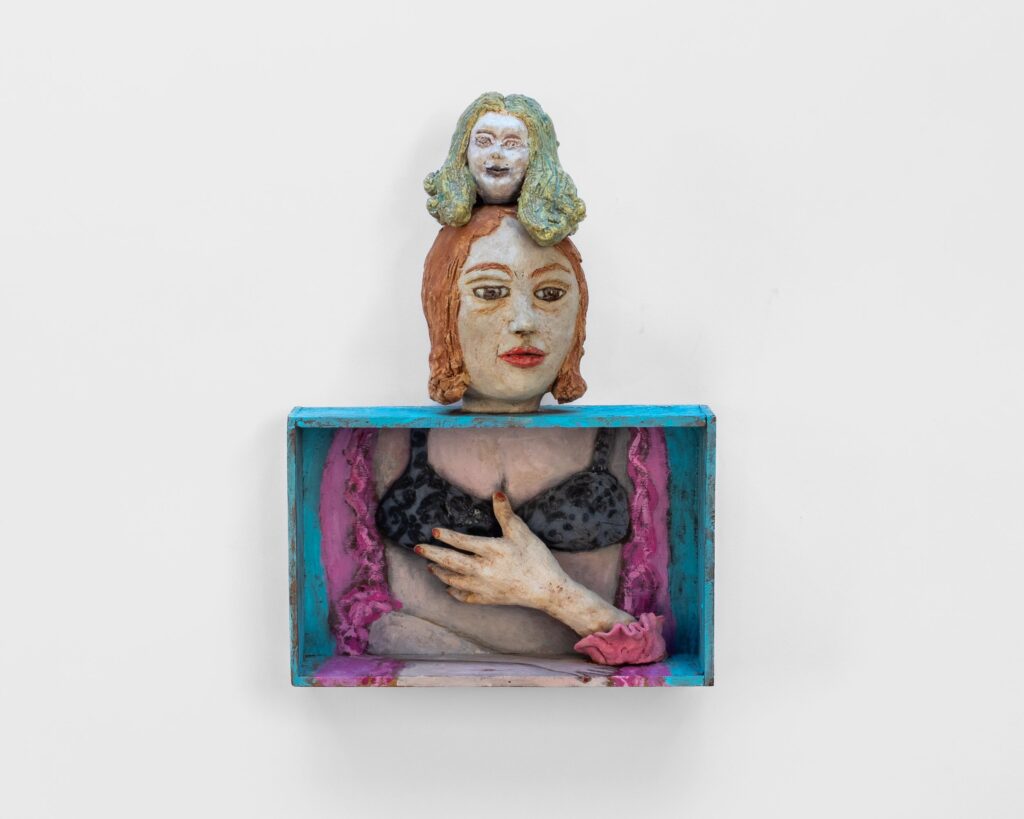
Across the room, Ruttenberg’s Double “D” is, ironically, small in stature and easy to miss. The titular appendages reveal themselves on the inside of a cigar box, its top and sides painted in a lurid teal which, together with a black brassiere and Barbie-pink sleeves, lends the fleshtones inside the shadowy box a sickly, almost dead hue. The ceramic head perched atop the cigar box has a healthier look, but the second head sprouting from its skull, like Athena rising from Zeus’ cranium, is a ghostly white with black lips and green hair. In Double D, the ceramic elements–both heads, an arm-–are inarguably a part of the wall-hanging sculpture, not merely decoration appended to it. But the same can be said for Hier’s pieces: even in See Through People, where the ceramic lobster literally frames the painted figure of a nude woman, spliced in half by a third panel, like a gutted fish, the similarly halved lobster is essential to the understanding of the piece. Hier and Ruttenberg both freely make use of an artform that has often been denigrated as mere craft or belonging to the so-called ‘decorative arts’2 to remix and remold the public’s conception of what belongs in galleries.
The choice of ceramic for this purpose is neither immaterial nor an accident. Ceramics, needlework, embroidery and similar creative forms that have long been associated with the feminine realm of craft have also long been discounted and considered not fine art. In the 1970s and 80s, at least partly in response to critics like Greenberg who elevated minimalism at the expense of ‘the decorative’, at the same time that Ruttenberg began showing, feminist artists Valerie Jaudon and Joyce Kozloff boldly embraced pattern and decoration in art, claiming that “the prejudice against the decorative has a long history and is based on hierarchies: fine art above decorative art, Western art above non-western art, men’s art above women’s art”.3 By taking up ceramics and incorporating them into her practice, Hier also becomes part of this lineage of feminist artists deliberately making use of the so-called decorative in serious fine art.
The lacquered ring of roses around Her Psychology Today, cast seafood in See Through People, and tower of doll-sized heads in Double D, all stand in as totems, both for the finely painted china vases and embroidered tapestries that the long lineage of male, western critics have relegated to “decorative arts” wings in mainstream art museums, and for the countless hours of labor that women have historically spent creating crafts” without being considered artists. By embracing this sort of labor, combining it with the lineage of western fine art like oil on linen and Hier does, and placing it on the pristine white walls of a New York gallery, the women featured in Between the lines are reclaiming and redefining the meaning of the term “fine art”. And at the same time, by featuring subjects like wedding cakes and stockinged legs, nude women and fish, lingerie and a self generating greek goddess, Hier and Ruttenberg demonstrate that form and meaning can be wed together outside the realm of minimalism or abstract expressionism.
- It is unlikely that mid-century critic Clement Greenberg and virulent defender of keeping fine art unsullied by separating it from craft, who once referred to the decorative as “the specter that haunts modernist painting” in the midst of an essay where he discusses how artists might “overcome” the decorative elements in their work through scale and scale rather than “dramatiz[ing] the problem by increasing the tension between decorative means and nondecorative ends” would consider the ceramic elements in Hier’s work in a positive light. Clement Greenberg “Milton Avery” in Art and Culture: Critical Essays, (Boston: Beacon Press, 1961), 200. ↩︎
- While today we have museums like the Museum of Art and Design in New York City with the end goal of existing to “collect, display, and interpret objects that document contemporary and historic innovation in craft, art, and design [as it] celebrates the creative process through which materials are crafted into works that enhance contemporary life” as well as whole wings of major institutions like The metropolitan Museum of Art dedicated to the so-called “decorative arts,” and yet ceramics, tapestries, clothing, and illuminated manuscripts remain ghettoized and left out of most mainstream fine art discussions. ↩︎
- Valerie Jaudon and Joyce Kozloff, “Art Hysterical Notions of Progress and Culture,” 1978 ↩︎