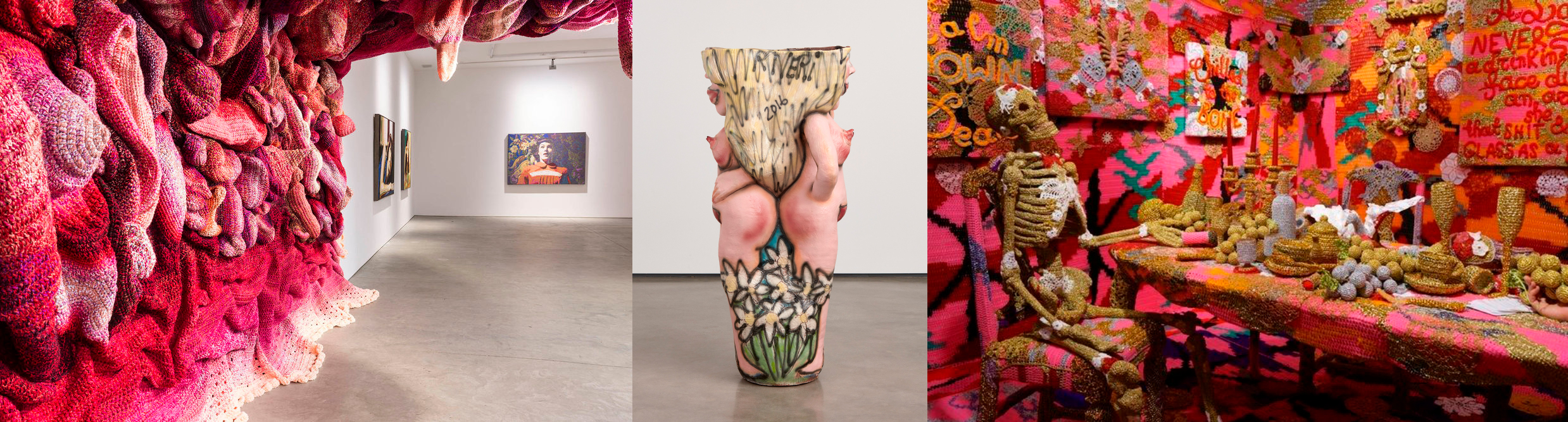
OLEK, Frances Goodman and Ruby Neri
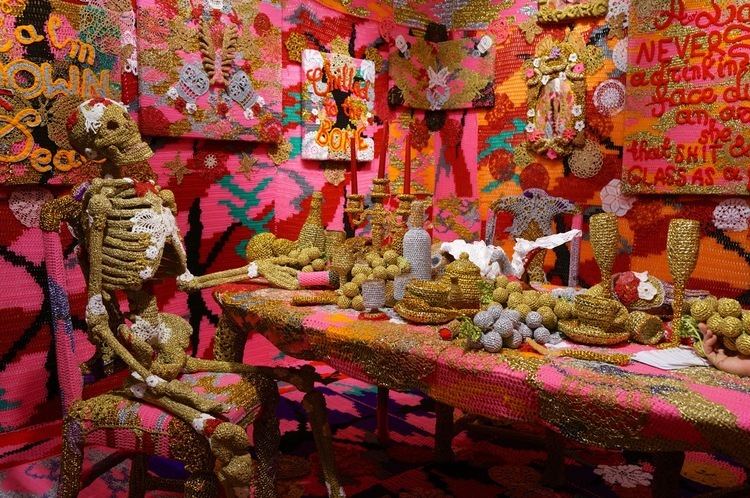
In an former ironworks in Avesta Sweden, visitors to Verket walked over and inside of a partially decayed two room structure completely covered in crocheted flowers, glittering rhinestones, and references to feminine allure spelled out in infinite intricate stitches—a piece by the artist known as OLEK. In New York City at Richard Taittinger—a small gallery on the Lower East Side—millions of arcylic nails form alien orifices hanging from the walls and ceilings, or propped on the floor; South African artist Frances Goodman’s works, which like OLEK’s self-consciously plays with the idea of stereotypical femininity, blurs the line between painting and sculpture. Artist Ruby Neri’s recent show at Los Angeles’ David Kordansky Gallery consisting of larger than ceramic pieces in the shape of Richard Crumb-esque buxom women more closely resembles typical objets d’art, but Neri too deliberately elevates mundane objects of domesticity—ceramic flower post—to the level of high art.
The traditional distinction between objects of virtu and those of use is no longer as ingrained as it was even in the 19th century. In order to maintain the distinction between objects of art and those of use, one would have to ignore that pottery can be beautiful in and of itself or that art objects which serve as political propaganda—as both the expressionist and socialist realism styles of the cold war inarguably did—are, at least to someone, useful. Still, fabric arts, pottery, and, yes, cosmetics, have long been relegated to a second tier status in discussions of aesthetics. So too has the domestic realm with which they have traditionally been associated.
Of late an increasing number of artists, many of whom were assigned female at birth or identify as queer, have ostentatiously reclaimed pottery, fabric and other unconventional art materials, creating art objects which directly challenge this denigration of the feminine both in form and in meaning. Ruby Neri’s work not only insists that ceramic pottery is a legitimate artistic medium but also flaunts the female form. OLEK’s work touches on a number of issues, including the rights of immigrants and societal degradation of aging femininity.
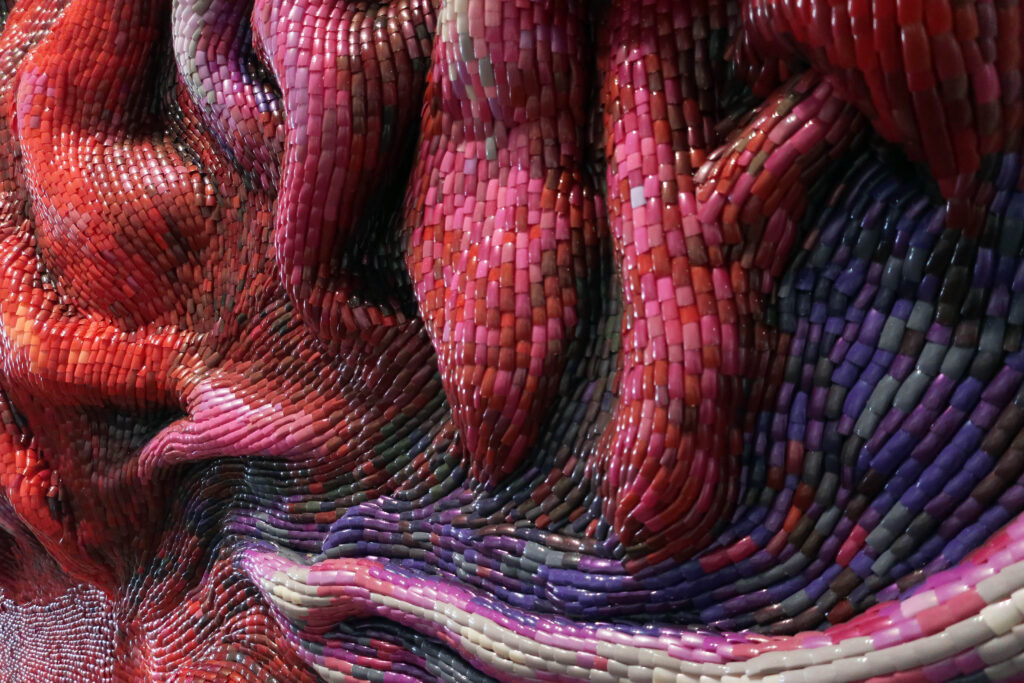
And yet, in a lot of ways the traditionally feminine is still ghettoized. The Whitney Museum of American Art currently has an entire floor dedicated to artists who have chosen to “reclaim visual languages that have typically been coded as feminine, domestic, or vernacular.” While this is a step in the right direction, the fact that these artists are being exhibited in this segregated way, and not on the basis of what they had to say, indicates that such visual languages are certainly still not wholly accepted by the gatekeepers of the art world. Perhaps in another 50 years critics will also stop referring to ‘women artists’ and well meaning curators will stop putting on exhibitions in which the artists have nothing in common but the gender they were assigned at birth. For now, Goodman’s overpowering fabric sculpture Comfort Her and OLEK’s Run Away From Me Now stand in mute testimony to the power of the artistic voice.